

Butterflies are synonymous with gentle beauty, but what if, under those bright colors and bouncy flutters, there’s another side to butterflies… one that’s a little more rough and tumble? By now, some butterflies that pupated earlier in the season are looking pretty tattered, but they’re still out there flying from flower to flower, doing the important work of pollination. I would argue that any animal that survives in the wild is pretty hardcore, but there are a couple of butterflies in Maine I think are certified rock ‘n’ roll. These are the skippers and the Harvester, and you can find both in a meadow or garden near you, all summer long.
Skippers

Have you ever tried taking a photo of a butterfly in flight? It’s humbling, to say the least. Butterflies and moths fly erratically to evade predators, which makes nailing them down for a photo nearly impossible until they choose to land. Most species cruise at five to twelve miles per hour, which ain’t nothing for an animal weighing less than a paper clip, but there’s one type of butterfly that leaves the rest in the dust. Skippers are in the family Hesperiidae, and they have the unique ability to fly up to thirty-seven miles per hour! For comparison, Usain Bolt set a world record when he reached 27.78 mph in a 100-meter race (Bolt weighed about 94,000 paper clips during his sprinting career).
More than thirty species of skippers live in Maine, from the Long Dash (Limochores mystic) to the Pepper and Salt Skipper (Amblyscirtes hegon). Some, called the “grass skippers,” hold their wings in a unique position while resting: the forewings are held open in a V, and the hind wings are under them, spread out horizontally. They look like little fighter jets. This shape is diagnostic to their identity as grass skippers. As the name suggests, their host plants are various species of native grass and sedges. “Spread-wing skippers” hold both sets of wings out horizontally, the classic pose of many other butterflies and moths. Nearly all skippers have antenna tips that bend like a hook.
So how on earth can these little guys keep pace with a greyhound? It starts with the combination of large, flexible wings and some crafty physics. If you watch a butterfly in slow motion, you’ll see that their wings actually clap together behind their heads on the upstroke. This is the secret to their speed. A pocket of air gets trapped between the flexible, cupped wings and then pushed out, creating a jet of air behind them that propels them forward (like a squid does in water).
You can simulate this action by touching the heels of your hands to each other and then rolling your hands together. Air is being pushed out as that V between your hands shrinks. That’s the jet that propels butterflies forward. Add to that the skippers’ exceptionally strong thorax muscles and relatively small wing-to-body ratio (for a butterfly), and you get the ability to flap very quickly with a lot of power behind each flap. Skippers also have one of the fastest “startle reflexes” in the animal kingdom, with recorded reaction times of less than 17 milliseconds (it takes a human motorist about 700 milliseconds to put a foot on the brake after seeing a red light). That’s one heck of a nervous system!
Skippers’ power is all a function of their forewings. Butterfly hindwings provide essentially no lift or acceleration, but they do aid in their spectacular maneuvering ability. They function like paddles of a canoe, turning the insects this way and that to create that frustratingly unpredictable flight pattern. Skippers get their name from their extra jumpy flight. It’s hypothesized that the large wings, bright colors, and bold patterns that butterflies are known for are all signals, telling would-be predators “I’m one of those insects that’s really annoying to chase.” We could take it as nature’s invitation to put down the camera and live in the moment!
Harvesters
The next butterfly that I insist you know about is an unassuming brown and orange species named the Harvester (Feniseca tarquinius). The name sounds rather charming until you learn what they’re harvesting. Harvesters are the only obligate carnivore butterflies in North America, eating exclusively aphids during its larval (caterpillar) stage.

They’re commonly found on colonies of Woolly Alder Aphids, which is where I first stumbled upon Harvester caterpillars. Woolly Alder Aphids are neat little critters in their own right. They produce white, waxy filaments on their backs that make them look like tiny, round sheep. You can find them in groups covering alder twigs. They cause minimal damage to the tree, but do produce a sticky honeydew that can be a nuisance if a colony is located above something you don’t want to be sticky, like a parked car. These aphids are often tended to by ants that consume the sugary liquid.

Female adult Harvesters insert their eggs within colonies of Woolly Alder Aphids. When the larvae hatch, they begin feeding on aphids. Pointy mouthparts impale the little bugs and suck out their juicy innards. They sometimes cover themselves in the woolly bodies of their prey to disguise themselves from predators, and perhaps from the ants that prefer their aphids living. There’s research to suggest that chemical camouflage may also help Harvesters avoid the notice of protective ants. The outside of the caterpillars’ bodies may have a similar chemical composition to that of their prey, the woolly aphids. This might help them fly under the radar of the ants, which rely heavily on their senses of smell and taste to navigate the world. This might also explain why the ants seem to crawl on caterpillars as they do the aphids.
Harvester caterpillars grow rapidly thanks to all that protein, and may pupate after only a week or two of feeding. Their chrysalis looks like a bird dropping at first glance, which is an adaptation to avoid predation, but on a double-take, you might just see a monkey face staring back at you. As adults, Harvesters also take advantage of the aphids’ honeydew, preferring it over flower nectar. This unique lifestyle may be explained by the fact that Harvesters are a monotypic species, meaning that it’s the only member of its genus, Feniseca. Butterflies evolved from ancient nocturnal moths, which probably ate mosses, liverworts, fern spores, and pollen. Ninety-nine percent of modern Lepidoptera (moth and butterfly) species are herbivores. Of the Lepidoptera that eat animals, very few are exclusively carnivorous.
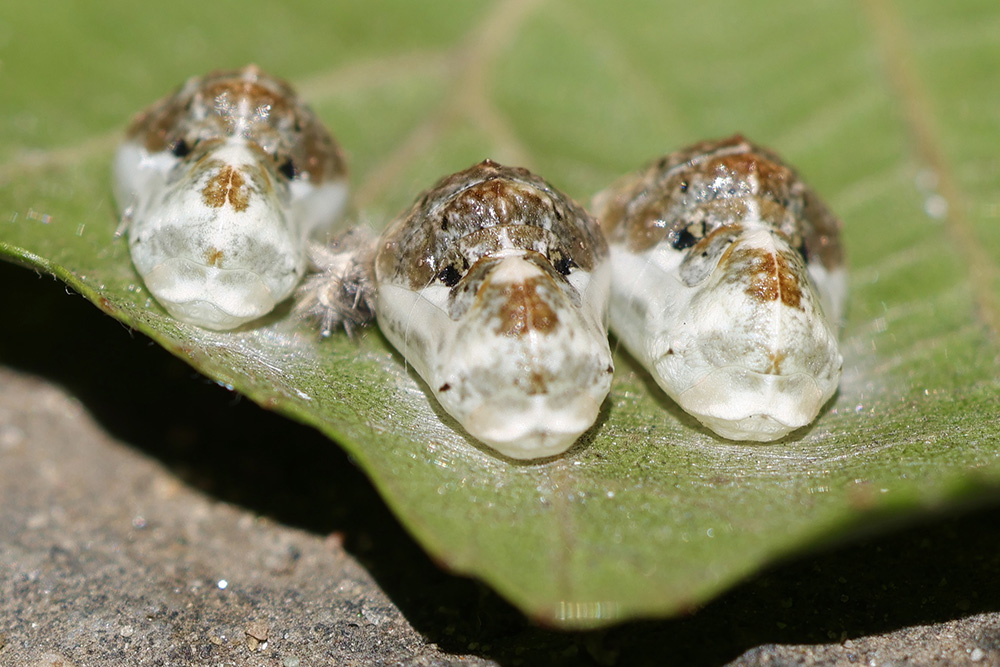
To find Harvesters, look for their prey. To find their prey, look for their host plants. There are many types of woolly aphids, belonging to the subfamily Eriosomatinae. Each has a preferred plant host, but alders, which grow at the edges of fresh water bodies, are abundant and easy to find in Maine. Woolly Alder Aphids also use Silver Maples, which you may find in wet soil near alders. Both the speedy skippers and hungry Harvesters rely on native plants to host their larvae. Planting natives (and leaving them where they already grow) is one of the best things you can do to preserve populations of these formidable (and beautiful) pollinators.
