

Bird bodies are amazing. That can be assumed by watching them zip around in the air at twice the speed of a human on foot. Challenges like temperature regulation, migration, and diving push birds’ bodies to the limit, and high mortality rates are a fact of life in the bird world. It’s estimated that a third of the bird population that winters in the continental US doesn’t make it to spring, and mortality rates for some species can be up to fifteen percent higher during migratory periods than stationary ones. Even so, billions of birds are currently finding enough food, staying warm, staying cool, avoiding hawks, cats, and windows, and flying thousands of miles between breeding and nonbreeding areas. We’re not privy to most of birds’ lives, but research has unraveled some mysteries of how birds beat the odds. What can seem like magic is actually an orchestra of clever adaptations, evolved over millions of years. Here are some of my favorite features of avian physiology that you can observe this fall in Maine, in case you needed more reasons to be awed by birds!
Fueling up
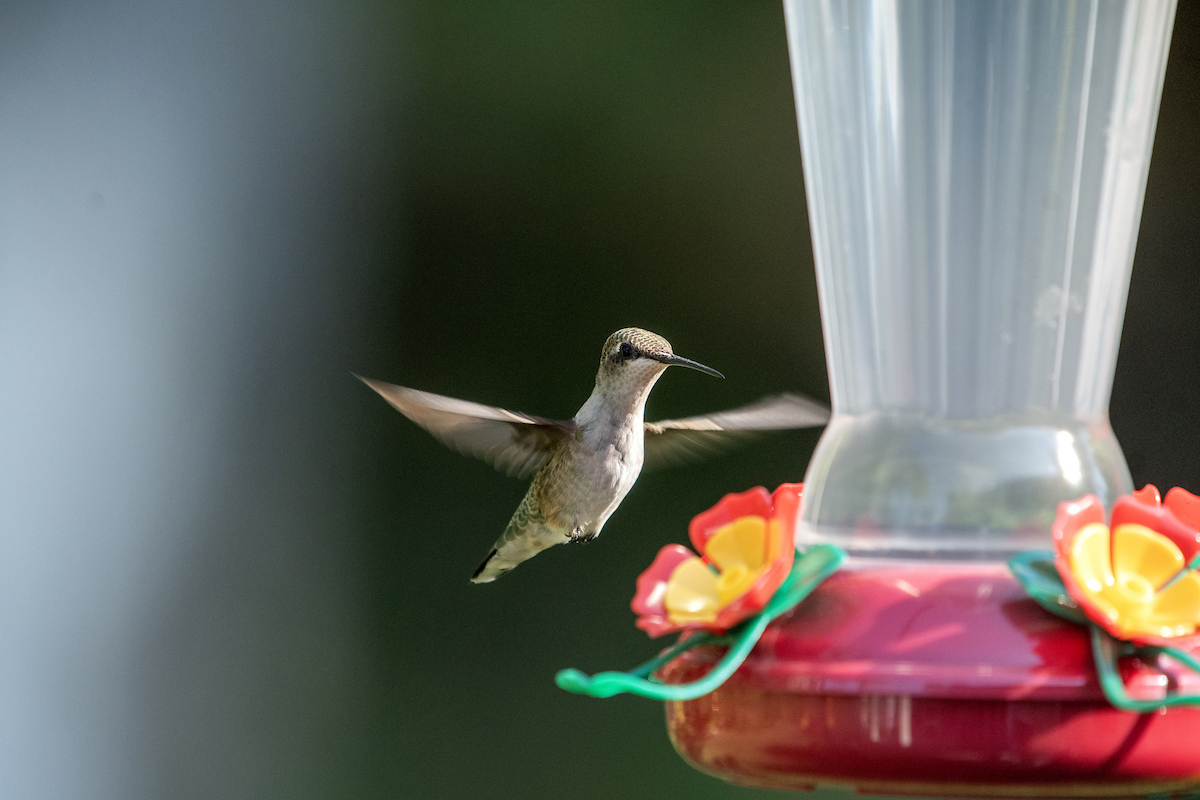
Avian digestion is worth its own article, but for now, I’ll highlight a gastronomical phenomenon that you might be noticing right now at your feeders– hyperphagia. This is a fancy way of describing migratory birds’ insatiable appetite as they prepare for their southbound journeys. A Ruby-throated Hummingbird, for example, nearly doubles its weight in the two weeks before it migrates. These calories are stored as fat, which is a bird’s primary fuel during these long flights. This is notable! We mammals primarily use carbohydrates as fuel. Birds have evolved to use fat because it’s lighter than carbohydrates and contains more energy per gram. A bird flying thousands of miles wants to maximize energy and minimize weight. Seeds and insects contain fat, but you might be wondering about those nectar-guzzling hummingbirds. Nectar isn’t particularly high in fat, but the little birds make it work: hummingbird livers make special enzymes that are able to convert the sugars in nectar into fats through a process called lipogenesis. We do this too, but since we use most of the sugars we consume right away in carbohydrate form, lipogenesis only kicks in when we consume more sugars than we need. This enzyme activity evolved with those long beaks and special nectar-absorbing tongues to help hummingbirds exploit a resource few other birds can.
Most adult hummingbirds have moved south, and this year’s young are starting to clear out too, but our Staff Naturalist Doug Hitchcox recommends keeping feeders up through October. We’re seeing increasing numbers of Western species like Rufous Hummingbirds in Maine in the fall. If you have a suspicious hummingbird at your feeder after October 15th, email naturalist@maineaudubon.org.

Fluffing up
This winter, listen for the high-pitched chatter of Golden-crowned Kinglets. These birds weigh as much as a teaspoon of salt, half the size of a chickadee, and yet they’re year-round Maine residents. Most birds utilize torpor in cold conditions, but not these guys. Torpor is a state of depressed body temperature and metabolism which conserves energy. It’s similar to hibernation, but used temporarily, mostly at night. By shirking torpor, the kinglets must maintain a body temp of 111 degrees fahrenheit all day and night, even when temperatures dip to 20 degrees below zero. That could mean a difference of 130 degrees fahrenheit between their bodies and the outside air. During the day, they move constantly, foraging all day, nonstop, to eat enough calories to survive. The body heat they generate is trapped remarkably well by a thick layer of ridiculously insulating down feathers that they can fluff up to trap more air.
All birds have tiny muscles at the base of their feathers that adjust the angle at which they stick out. When birds fluff up their feathers, it’s called piloerection. When we get goosebumps, or when my cat’s tail puffs up, that’s also piloerection, but with hair follicles instead of feathers. The naturally insulative structure of feathers combined with piloerection and an impressively fast metabolism turning calories into heat allows tiny Golden-crowned Kinglets to live in this climate year-round. It’s worth noting that almost 90% of them don’t survive their first year (odds are against most first-year songbirds, but 90% is pretty bad!). That, to me, proves just how remarkable their feathers are that any of them can survive at all. If you see these teeny birds flitting in and out of the boughs of trees this winter, give them a little nod!

Deep dives
The waters of Maine are about to be inundated with ducks. Common Eider, Long-tailed Ducks, mergansers, scoters, scaups, and the fan favorite Harlequin Ducks, will all descend into the Gulf of Maine where they seek open water and milder weather than their arctic and subarctic breeding grounds. Some birders call it the most wonderful time of the year. These are diving ducks, as opposed to dabbling ducks like Mallards, who only tip upside down in shallow water to nibble the roots of aquatic plants. Diving ducks usually stay underwater for ten to thirty seconds, but some species can remain submerged for up to a minute. Long-tailed Ducks can dive over two hundred feet down (the height of a twenty-story building).
To reduce their buoyancy for a dive, birds take as little air as possible with them underwater. They press their feathers tight to their bodies to squeeze out trapped air. They also exhale. Yes, that’s correct– they exhale before diving. They can afford to do this without drowning because of a neat trick of their respiratory system. When water touches receptors in their nostrils, a dive reflex kicks in. The reflex slows their heart rate to conserve oxygen, then rations that oxygen stored in their blood to their heart and nervous system. This reflex prioritizes essential functions that keep them alive and help them forage under water. Marine mammals exhibit the same extreme physiological response to submersion in water, but humans can do it too! We can’t dive as long or as comfortably as animals who were born for it, but it’s better than nothing. The human dive reflex also causes babies to hold their breath and close their airways (this feature starts to disappear after six months of age).
Bonus! The white stuff…

I can’t leave you without sharing one of my favorite bird facts. Have you ever wondered what the white stuff is in bird poop? Of course you have! The white is uric acid, which comes from that incredible liver. Uric acid is what’s left after the liver synthesizes nitrogenous waste products. The mammal equivalent is urea. While made synthetically for nitrogen fertilizers, historically it came from animals. The problem with urea is its water solubility. If birds produced urea, like mammals, an embryo’s waste would dissolve in egg fluid and the growing bird would poison itself. Uric acid isn’t water soluble, so it can be stored in a special section of the egg, away from the developing embryo. Hence the white part of bird poop! This is a feature of scat from other egg-laying animals, like snakes and lizards. You’re welcome!
